
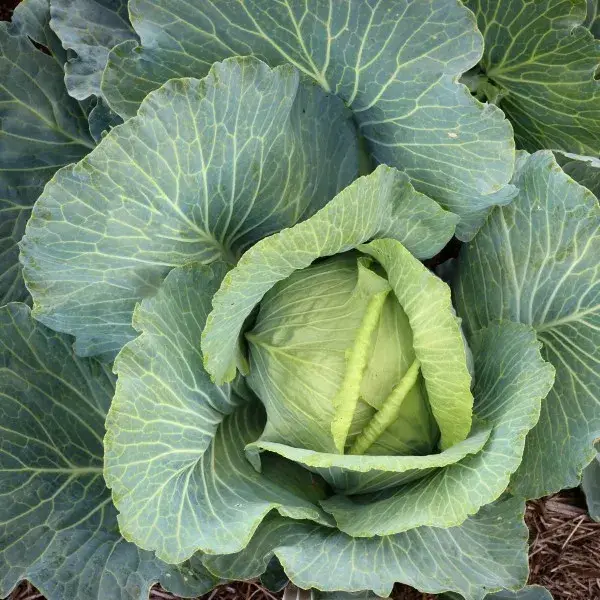
Cabbage: Drumhead

Botanical Name:

Brassica oleracea var. capitata

Family:

Crop Type:

Other Names:

Headed Cabbage; White Cabbage; Kool (Afrikaans); iKhabishi (isiZulu); iKhabetshi (isiXhosa)

Lifecycle:

Biennial, grown as annual

Uses:

Food (fresh, cooked, fermented as sauerkraut); processing; fodder (outer leaves)

Cabbage (Drumhead) is a cool-season leafy vegetable in the Brassicaceae family. Plants form large, dense heads of tightly wrapped leaves on a short, thick stem, with outer leaves ranging from pale to blue-green.

The head, composed of overlapping leaves, is the edible part, consumed fresh, cooked, fermented, or processed. Inner leaves are pale and tender, while outer wrapper leaves are removed before use.

Cultivated in mild to cool conditions with consistent moisture, suited to winter and spring production in many regions. Drumhead types are noted for producing large, rounded, flattened heads with firm texture, suitable for storage, sauerkraut production, and general culinary use.
Climate

Climate Suitability:

Cool to mild seasons; suited to winter production in most SA regions

Frost Tolerance:

Light frost tolerant

Heat Tolerance:

Moderate

Sun Type:

Full sun

Soil Texture:

Loam to clay loam

Drainage Requirement:

Moist but well-drained

Preferred pH Range:

6.0–7.5 pH

Water Requirement:

Moderate to high

Irrigation Type:

Drip; Sprinkler; Micro Irrigation

Propagation

Propagation Type:

Seed

Propagation Season:

Late summer to autumn; spring in cool areas

Germination Days:

7–10 days

Days to Transplant:

28–42 days

Propagation Notes:

Raise seedlings in trays; transplant strong seedlings.

Planting

Planting Season:

Autumn to winter; spring in cool areas

Plants Per Square Foot:
Square Foot Method

1 per ft²

Plant Spacing:
Square Foot Method

30 cm

Plant Spacing:
Traditional Method

40–50 cm

Row Spacing:
Traditional Method

60–75 cm

Container Suitable:

Conditional; large containers

Container Notes:

Hydroponic Compatible:

Conditional

Hydroponic Systems:

Hydroponic Notes:

Aquaponic Suitable:

Conditional

Aquaponic Notes:

Aromatic herbs and alliums may deter cabbage pests; benefits from interplanting with non-brassica crops.
Other brassicas increase clubroot and pest pressure; strawberries and tomatoes traditionally avoided.

No crops on recorded.

Please contact us should you feel that this is incorrect.

Pests & Diseases

Pest Types:

Aphids; Diamondback Moth; Cabbage Worm; Cutworms; Bagrada Bug

Pest Control:

Use insect netting, crop rotation, scouting, biological controls (Bt) and remove infested leaves.

Disease Types:

Black rot, Downy mildew, Clubroot, Damping-off, Alternaria leaf spot

Disease Control:

Rotate brassicas (4+ years for clubroot), manage soil pH, ensure airflow, use disease-free seed and remove infected residues.

Harvest

Planting Season:

Autumn to winter; spring in cool areas

Plant Spacing:
Square Foot Method

30 cm

Plant Spacing:
Traditional Method

40–50 cm

Row Spacing:
Traditional Method

60–75 cm

Nutrition

Edible Parts:

Leaves; Head

Reference Food State:

Raw cabbage

Serving Size:

100 g

Nutrition Basis:

Per 100 g raw edible portion

Calories (kcal):

25 kcal

Calories (kj):

105 kj

Total Carbohydrates:

5.8 g

Protein:

1.28 g

Total Fat:

0.1 g

Dietary Fibre:

2.5 g

Starch:

0 g

Total Sugars:

3.2 g

Monounsaturated Fat:

0.017 g

Omega-3 Fatty Acids:

0.04 g

Omega-6 Fatty Acids:

0.02 g

Polyunsaturated Fat:

0.017 g

Saturated Fat:

0.034 g

Trans Fat:

0 g

Calcium:

40 mg

Chromium:

0 mcg

Copper:

0.019 mg

Iron:

0.47 mg

Iodine:

0 mcg

Magnesium:

12 mg

Manganese:

0.16 mg

Molybdenum:

0 mcg

Phosphorus:

26 mg

Potassium:

170 mg

Selenium:

0.3 mcg

Sodium:

18 mg

Zinc:

0.18 mg

Vitamin A:

5 mcg RE

Thiamin:
Vitamin B1

0.061 mg

Riboflavin:
Vitamin B2

0.04 mg

Niacin:
Vitamin B3

0.234 mg NE

Pantothenic Acid:
Vitamin B5

0.212 mg

Vitamin B6:

0.124 mg

Biotin:
Vitamin B7

0 mcg

Folate:
Vitamin B9

43 mcg

Vitamin B12:

0 mcg

Vitamin C:

36.6 mg

Vitamin D:

0 mcg

Vitamin E:

0.15 mg alpha-tocopherol

Vitamin K:

76 mcg

Recipes