
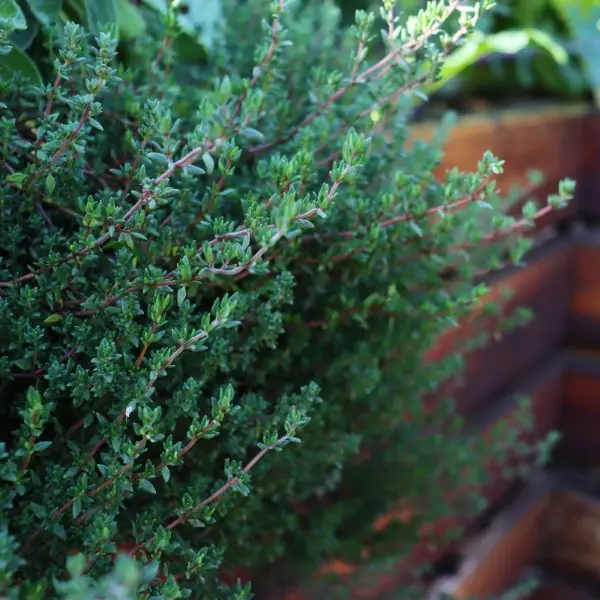
Thyme

Botanical Name:

Thymus vulgaris

Family:

Crop Type:

Other Names:

Common Thyme; Garden Thyme; Tiemie (Afrikaans)

Lifecycle:

Perennial, evergreen

Uses:

Culinary herb (fresh or dried for seasoning); ornamental groundcover; pollinator attractant

Thyme is a perennial herb in the Lamiaceae family. Plants form low-growing, woody subshrubs with small, aromatic, grey-green leaves on wiry stems, producing clusters of tiny pink to purple flowers attractive to pollinators.

Leaves and flowering tops are the edible parts, used fresh or dried as a culinary seasoning with earthy, slightly minty flavour. Flavour is most concentrated just before flowering.

Cultivated in well-drained, lean soils in full sun; drought-tolerant once established and suited to rock gardens, borders, and containers. Notable for its aromatic essential oils, traditional culinary uses, and suitability for xeriscaping.

Climate

Climate Suitability:

Mediterranean to warm temperate; tolerates drought; suited to Western Cape and mild inland areas

Frost Tolerance:

Light frost tolerant

Heat Tolerance:

High

Sun Type:

Full sun

Soil Texture:

Sandy loam to loam, tolerates poor soils

Drainage Requirement:

Well-drained

Preferred pH Range:

6.0–8.0 pH

Water Requirement:

Low; drought tolerant

Irrigation Type:

Drip; Micro Irrigation; Manual Watering

Propagation

Propagation Type:

Seed; Cutting; Division

Propagation Season:

Spring to summer

Germination Days:

14–28 days

Days to Transplant:

42–70 days

Propagation Notes:

Seed germinates slowly; cuttings or division faster and more reliable.

Planting

Planting Season:

Spring to summer

Plants Per Square Foot:
Square Foot Method

9 per ft²

Plant Spacing:
Square Foot Method

10 cm

Plant Spacing:
Traditional Method

15–25 cm

Row Spacing:
Traditional Method

25–30 cm

Container Suitable:

Yes

Container Notes:

Hydroponic Compatible:

Yes

Hydroponic Systems:

Hydroponic Notes:

Aquaponic Suitable:

Yes

Aquaponic Notes:

Aromatic companion that may deter cabbage pests; suits Mediterranean herb and vegetable gardens.

No crops on recorded.

Please contact us should you feel that this is incorrect.

Avoid very moist conditions and dense shade from taller companions.

No crops on recorded.

Please contact us should you feel that this is incorrect.

Pests & Diseases

Pest Types:

Aphids; Spider Mites; Thrips; Whitefly

Pest Control:

Maintain plant health, avoid overwatering, prune for airflow and use biological controls if needed.

Disease Types:

Root rot, Grey mould (Botrytis), Leaf spot

Disease Control:

Ensure excellent drainage, avoid wet conditions, maintain airflow and remove infected material.

Harvest

Planting Season:

Spring to summer

Plant Spacing:
Square Foot Method

10 cm

Plant Spacing:
Traditional Method

15–25 cm

Row Spacing:
Traditional Method

25–30 cm

Nutrition

Edible Parts:

Leaves; Stems

Reference Food State:

Fresh leaves

Serving Size:

100 g

Nutrition Basis:

Per 100 g fresh leaves

Calories (kcal):

101 kcal

Calories (kj):

422 kj

Total Carbohydrates:

24.45 g

Protein:

5.56 g

Total Fat:

1.68 g

Dietary Fibre:

14 g

Starch:

0 g

Total Sugars:

0 g

Monounsaturated Fat:

0.081 g

Omega-3 Fatty Acids:

0.44 g

Omega-6 Fatty Acids:

0.085 g

Polyunsaturated Fat:

0.532 g

Saturated Fat:

0.467 g

Trans Fat:

0 g

Calcium:

405 mg

Chromium:

0 mcg

Copper:

0.555 mg

Iron:

17.45 mg

Iodine:

0 mcg

Magnesium:

160 mg

Manganese:

1.719 mg

Molybdenum:

0 mcg

Phosphorus:

106 mg

Potassium:

609 mg

Selenium:

4.6 mcg

Sodium:

9 mg

Zinc:

1.81 mg

Vitamin A:

238 mcg RE

Thiamin:
Vitamin B1

0.048 mg

Riboflavin:
Vitamin B2

0.471 mg

Niacin:
Vitamin B3

1.824 mg NE

Pantothenic Acid:
Vitamin B5

0.409 mg

Vitamin B6:

0.348 mg

Biotin:
Vitamin B7

0 mcg

Folate:
Vitamin B9

45 mcg

Vitamin B12:

0 mcg

Vitamin C:

160.1 mg

Vitamin D:

0 mcg

Vitamin E:

0 mg alpha-tocopherol

Vitamin K:

0 mcg

Recipes