
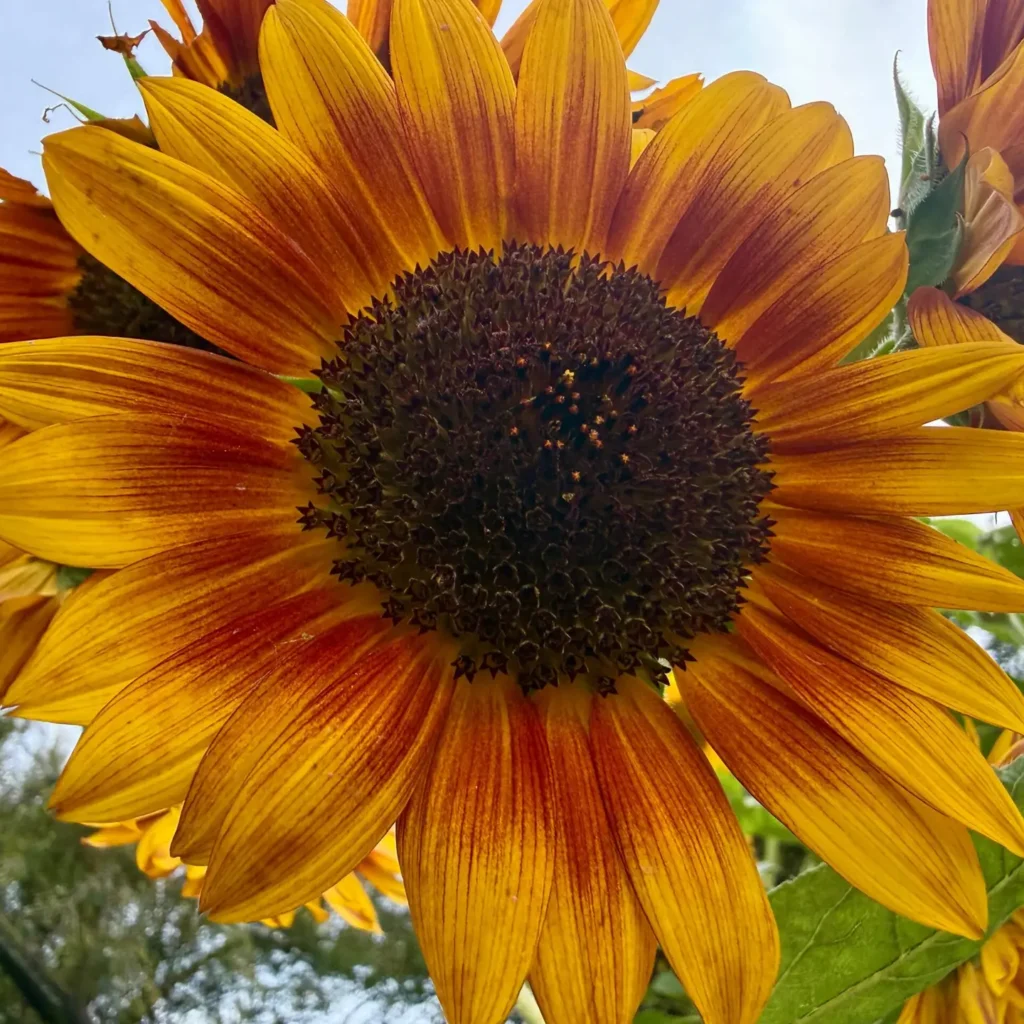
Sunflower: Tigers Eye

Botanical Name:

Helianthus annuus

Family:

Crop Type:

Other Names:

Common Sunflower; Sonneblom (Afrikaans); ilanga (isiZulu)

Lifecycle:

Annual

Uses:

Ornamental (cut flowers, garden display); food (seeds roasted, raw, oil extraction); fodder (stalks and heads); pollinator attractant

Sunflower (Tigers Eye) is a warm-season annual in the Asteraceae family, grown for ornamental flowers and edible seeds. Plants produce tall, sturdy stems with large, rough-textured leaves and characteristic composite flower heads.

Tigers Eye produces medium-sized flower heads with bicoloured petals in shades of gold, bronze, and burgundy radiating from a dark central disc. Seeds develop in the mature head and are edible when harvested and dried.

Cultivated in warm conditions with full sun, suited to borders, cut flower production, and seed harvest. Notable for its striking bicoloured petal pattern and appeal to pollinators.

Climate

Climate Suitability:

Warm temperate to subtropical; suited to most SA summer-rainfall regions

Frost Tolerance:

Frost sensitive

Heat Tolerance:

High

Sun Type:

Full sun

Soil Texture:

Loam to sandy loam

Drainage Requirement:

Well-drained

Preferred pH Range:

6.0–7.5 pH

Water Requirement:

Moderate; drought tolerant once established

Irrigation Type:

Drip; Sprinkler; Furrow; Rainfed

Propagation

Propagation Type:

Seed

Propagation Season:

Spring to early summer

Germination Days:

7–10 days

Days to Transplant:

14–21 days

Propagation Notes:

Direct sow after last frost; germinates quickly in warm soil; does not transplant well due to taproot.

Planting

Planting Season:

Spring to early summer after frost

Plants Per Square Foot:
Square Foot Method

1 per ft²

Plant Spacing:
Square Foot Method

30 cm

Plant Spacing:
Traditional Method

45–60 cm

Row Spacing:
Traditional Method

75–90 cm

Container Suitable:

Conditional; dwarf varieties only

Container Notes:

Hydroponic Compatible:

No

Hydroponic Systems:

Hydroponic Notes:

Aquaponic Suitable:

No

Aquaponic Notes:

Provides support for climbing crops; attracts pollinators; avoid planting near potatoes due to allelopathic effects.

No crops on recorded.

Please contact us should you feel that this is incorrect.

Sunflower residues may inhibit germination of some crops; avoid planting in same area consecutively.

No crops on recorded.

Please contact us should you feel that this is incorrect.

Pests & Diseases

Pest Types:

Aphids; Sunflower Moth; Birds; Cutworms; Stem Weevil

Pest Control:

Use bird netting for seed protection, monitor for moth larvae, maintain sanitation and apply biological controls where needed.

Disease Types:

Sclerotinia head rot, Downy mildew, Rust, Verticillium wilt, Phoma black stem

Disease Control:

Use resistant varieties, ensure airflow, rotate crops (3–4 years), avoid overhead irrigation and remove infected material.

Harvest

Planting Season:

Spring to early summer after frost

Plant Spacing:
Square Foot Method

30 cm

Plant Spacing:
Traditional Method

45–60 cm

Row Spacing:
Traditional Method

75–90 cm

Nutrition

Edible Parts:

Seeds

Reference Food State:

Dried seeds

Serving Size:

100 g

Nutrition Basis:

Per 100 g dried seeds

Calories (kcal):

584 kcal

Calories (kj):

2442 kj

Total Carbohydrates:

20 g

Protein:

20.78 g

Total Fat:

51.46 g

Dietary Fibre:

8.6 g

Starch:

0 g

Total Sugars:

2.62 g

Monounsaturated Fat:

18.528 g

Omega-3 Fatty Acids:

0.074 g

Omega-6 Fatty Acids:

23.049 g

Polyunsaturated Fat:

23.137 g

Saturated Fat:

4.455 g

Trans Fat:

0 g

Calcium:

78 mg

Chromium:

0 mcg

Copper:

1.8 mg

Iron:

5.25 mg

Iodine:

0 mcg

Magnesium:

325 mg

Manganese:

1.95 mg

Molybdenum:

0 mcg

Phosphorus:

660 mg

Potassium:

645 mg

Selenium:

53 mcg

Sodium:

9 mg

Zinc:

5 mg

Vitamin A:

3 mcg RE

Thiamin:
Vitamin B1

1.48 mg

Riboflavin:
Vitamin B2

0.355 mg

Niacin:
Vitamin B3

8.335 mg NE

Pantothenic Acid:
Vitamin B5

1.13 mg

Vitamin B6:

1.345 mg

Biotin:
Vitamin B7

0 mcg

Folate:
Vitamin B9

227 mcg

Vitamin B12:

0 mcg

Vitamin C:

1.4 mg

Vitamin D:

0 mcg

Vitamin E:

35.17 mg alpha-tocopherol

Vitamin K:

0 mcg

Recipes