
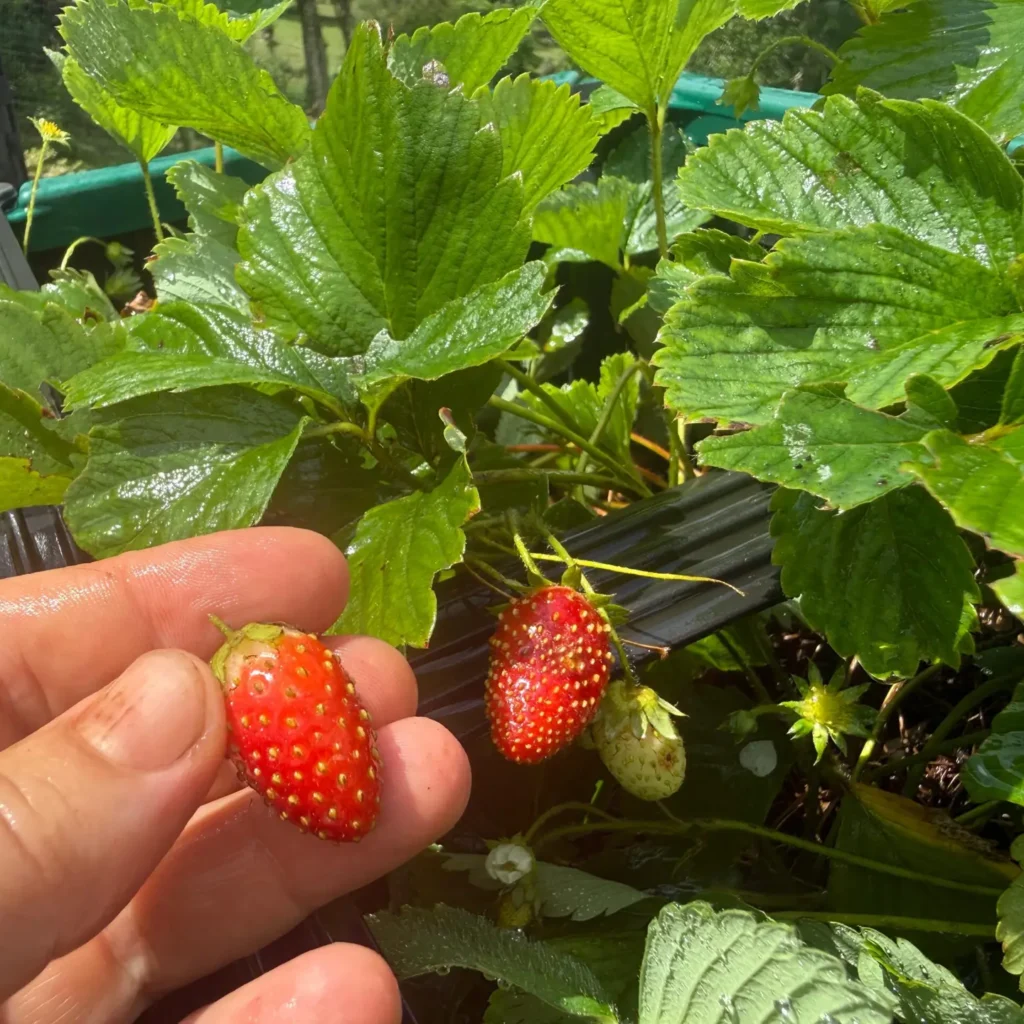
Strawberry

Botanical Name:

Fragaria × ananassa

Family:

Crop Type:

Other Names:

Garden Strawberry; Aarbei (Afrikaans); ijikijolo (isiZulu)

Lifecycle:

Perennial

Uses:

Food (fresh, frozen, jams, desserts); processing (juices, flavouring); ornamental groundcover

Strawberry is a low-growing perennial fruit crop in the Rosaceae family. Plants form compact rosettes with trifoliate, serrated leaves and produce runners for vegetative propagation.

Flowers are white with yellow centres, developing into aggregate accessory fruits with red flesh studded with small dry achenes (seeds) on the surface. The receptacle (commonly called the berry) is the edible part, consumed fresh, frozen, or processed.

Cultivated in cool to mild climates with well-drained soil, suited to open field, raised beds, and protected production systems. Notable for its distinctive aroma, sensitivity to waterlogging, and requirement for adequate chilling in some cultivar types.

Climate

Climate Suitability:

Cool to mild conditions; suited to highveld, coastal areas, and winter production in warmer regions

Frost Tolerance:

Light frost tolerant

Heat Tolerance:

Moderate; fruit quality declines in high heat

Sun Type:

Full sun to partial shade

Soil Texture:

Sandy loam to loam, organic-rich

Drainage Requirement:

Well-drained

Preferred pH Range:

5.5–6.8 pH

Water Requirement:

Moderate to high; drought sensitive

Irrigation Type:

Drip; Micro Irrigation

Propagation

Propagation Type:

Runner; Division

Propagation Season:

Autumn to early winter

Germination Days:

7–42 days

Days to Transplant:

28–42 days

Propagation Notes:

Plant certified disease-free runners; replace plants every 2–3 years.

Planting

Planting Season:

Autumn to early winter

Plants Per Square Foot:
Square Foot Method

4 per ft²

Plant Spacing:
Square Foot Method

15 cm

Plant Spacing:
Traditional Method

25–35 cm

Row Spacing:
Traditional Method

75–100 cm

Container Suitable:

Yes

Container Notes:

Hydroponic Compatible:

Yes

Hydroponic Systems:

Hydroponic Notes:

Aquaponic Suitable:

Yes

Aquaponic Notes:

Alliums and aromatic herbs may deter pests; legumes fix nitrogen for following crops; avoid verticillium hosts.

No crops on recorded.

Please contact us should you feel that this is incorrect.

Brassicas and solanums may harbour verticillium wilt affecting strawberries.

No crops on recorded.

Please contact us should you feel that this is incorrect.

Pests & Diseases

Pest Types:

Aphids; Spider Mites; Thrips; Slugs; Snails; Birds

Pest Control:

Use netting for birds, monitor for mites, maintain sanitation, apply biological controls and approved treatments when needed.

Disease Types:

Grey mould (Botrytis), Powdery mildew, Verticillium wilt, Crown rot, Leaf spot

Disease Control:

Use certified disease-free runners, ensure airflow, avoid overhead irrigation, rotate planting areas and remove infected material.

Harvest

Planting Season:

Autumn to early winter

Plant Spacing:
Square Foot Method

15 cm

Plant Spacing:
Traditional Method

25–35 cm

Row Spacing:
Traditional Method

75–100 cm

Nutrition

Edible Parts:

Fruit

Reference Food State:

Raw berries

Serving Size:

100 g

Nutrition Basis:

Per 100 g raw edible portion

Calories (kcal):

32 kcal

Calories (kj):

134 kj

Total Carbohydrates:

7.68 g

Protein:

0.67 g

Total Fat:

0.3 g

Dietary Fibre:

2 g

Starch:

0.04 g

Total Sugars:

4.89 g

Monounsaturated Fat:

0.043 g

Omega-3 Fatty Acids:

0.065 g

Omega-6 Fatty Acids:

0.09 g

Polyunsaturated Fat:

0.155 g

Saturated Fat:

0.015 g

Trans Fat:

0 g

Calcium:

16 mg

Chromium:

0 mcg

Copper:

0.048 mg

Iron:

0.41 mg

Iodine:

0 mcg

Magnesium:

13 mg

Manganese:

0.386 mg

Molybdenum:

0 mcg

Phosphorus:

24 mg

Potassium:

153 mg

Selenium:

0.4 mcg

Sodium:

1 mg

Zinc:

0.14 mg

Vitamin A:

1 mcg RE

Thiamin:
Vitamin B1

0.024 mg

Riboflavin:
Vitamin B2

0.022 mg

Niacin:
Vitamin B3

0.386 mg NE

Pantothenic Acid:
Vitamin B5

0.125 mg

Vitamin B6:

0.047 mg

Biotin:
Vitamin B7

0 mcg

Folate:
Vitamin B9

24 mcg

Vitamin B12:

0 mcg

Vitamin C:

58.8 mg

Vitamin D:

0 mcg

Vitamin E:

0.29 mg alpha-tocopherol

Vitamin K:

2.2 mcg

Recipes