
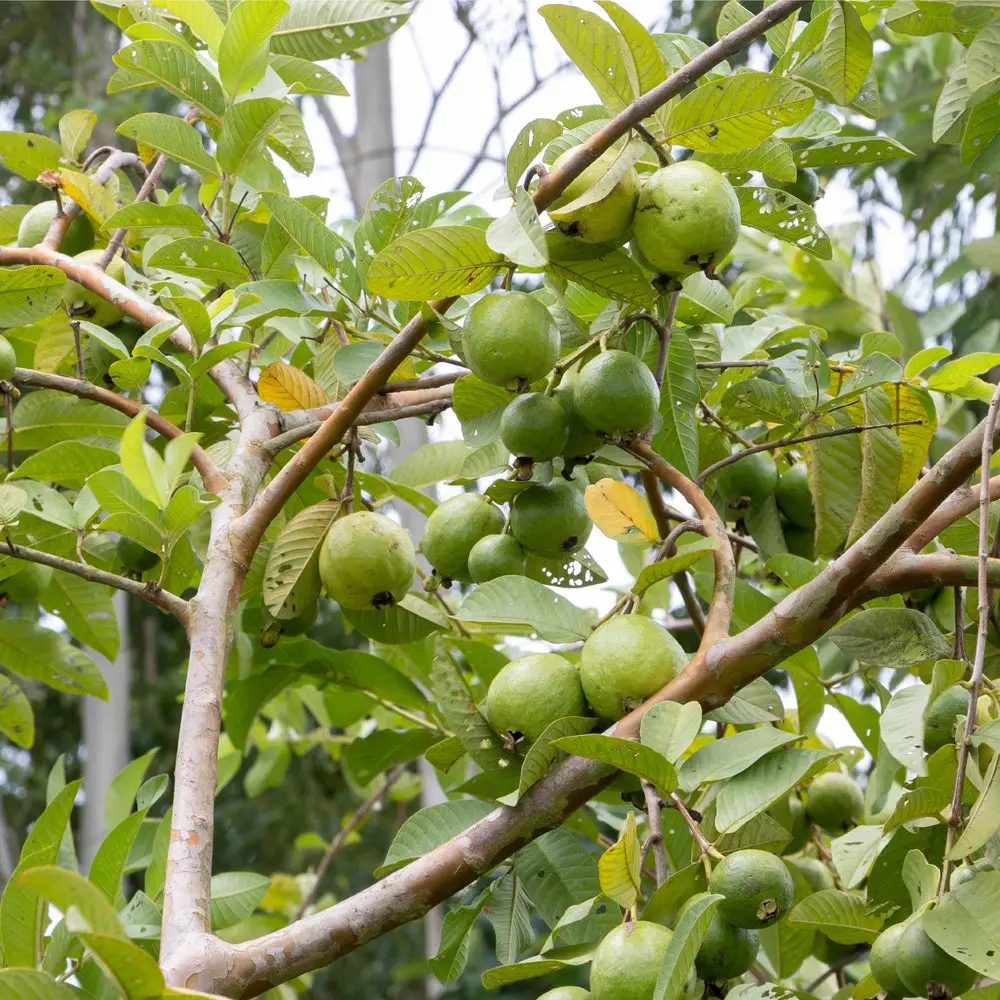
Guava

Botanical Name:

Psidium guajava

Family:

Crop Type:

Other Names:

Common Guava; Koejawel (Afrikaans); uGwava (isiZulu)

Lifecycle:

Perennial, evergreen

Uses:

Food (fresh, juiced, jams, jellies, paste); processing; fodder (leaves for livestock)

Guava is a subtropical to tropical fruit tree in the Myrtaceae family. Trees develop spreading canopies with smooth, peeling bark and oval, prominently veined leaves.

Fruits are round to oval with thin skin ranging from green to yellow, and flesh varying from white to pink or red depending on cultivar, containing numerous small hard seeds. Fruit flesh is the primary edible part, consumed fresh, juiced, or processed into jams, pastes, and preserves.

Cultivated in frost-free subtropical regions with adequate moisture and good drainage. Notable for high vitamin C content, aromatic fragrance, and tolerance of a wide pH range.

Climate

Climate Suitability:

Subtropical to tropical; frost-free areas of Limpopo, Mpumalanga, KwaZulu-Natal

Frost Tolerance:

Frost sensitive

Heat Tolerance:

High

Sun Type:

Full sun

Soil Texture:

Loam to sandy loam with organic matter

Drainage Requirement:

Well-drained

Preferred pH Range:

5.0–7.0 pH

Water Requirement:

Moderate; drought tolerant once established

Irrigation Type:

Drip; Micro Irrigation; Basin Irrigation

Propagation

Propagation Type:

Seed; Cutting; Grafting

Propagation Season:

Spring to summer

Germination Days:

14–56 days

Days to Transplant:

90–180 days

Propagation Notes:

Seed-grown plants variable; grafted or cutting-grown plants preferred for consistency.

Planting

Planting Season:

Spring to summer

Plants Per Square Foot:
Square Foot Method

0.25 per ft²

Plant Spacing:
Square Foot Method

60 cm

Plant Spacing:
Traditional Method

400–600 cm

Row Spacing:
Traditional Method

500–700 cm

Container Suitable:

Conditional; dwarf types in large containers

Container Notes:

Hydroponic Compatible:

No

Hydroponic Systems:

Hydroponic Notes:

Aquaponic Suitable:

No

Aquaponic Notes:

Legume groundcovers fix nitrogen; mulching companions suppress weeds and retain moisture.

No crops on recorded.

Please contact us should you feel that this is incorrect.

Avoid strong root competitors and crops requiring vastly different moisture regimes.

No crops on recorded.

Please contact us should you feel that this is incorrect.

Pests & Diseases

Pest Types:

Fruit Fly; Scale Insects; Mealybugs; Aphids; Guava Moth

Pest Control:

Use fruit fly traps and baits, sanitation, remove fallen fruit, monitor and apply approved controls where needed.

Disease Types:

Anthracnose, Algal leaf spot, Root rot (Phytophthora), Guava wilt

Disease Control:

Maintain tree health, ensure drainage, prune for airflow, remove infected material and use resistant rootstocks where available.

Harvest

Planting Season:

Spring to summer

Plant Spacing:
Square Foot Method

60 cm

Plant Spacing:
Traditional Method

400–600 cm

Row Spacing:
Traditional Method

500–700 cm

Nutrition

Edible Parts:

Fruit

Reference Food State:

Raw fruit

Serving Size:

100 g

Nutrition Basis:

Per 100 g raw edible portion

Calories (kcal):

68 kcal

Calories (kj):

284 kj

Total Carbohydrates:

14.32 g

Protein:

2.55 g

Total Fat:

0.95 g

Dietary Fibre:

5.4 g

Starch:

0 g

Total Sugars:

8.92 g

Monounsaturated Fat:

0.087 g

Omega-3 Fatty Acids:

0.112 g

Omega-6 Fatty Acids:

0.328 g

Polyunsaturated Fat:

0.401 g

Saturated Fat:

0.272 g

Trans Fat:

0 g

Calcium:

18 mg

Chromium:

0 mcg

Copper:

0.23 mg

Iron:

0.26 mg

Iodine:

0 mcg

Magnesium:

22 mg

Manganese:

0.15 mg

Molybdenum:

0 mcg

Phosphorus:

40 mg

Potassium:

417 mg

Selenium:

0.6 mcg

Sodium:

2 mg

Zinc:

0.23 mg

Vitamin A:

31 mcg RE

Thiamin:
Vitamin B1

0.067 mg

Riboflavin:
Vitamin B2

0.04 mg

Niacin:
Vitamin B3

1.084 mg NE

Pantothenic Acid:
Vitamin B5

0.451 mg

Vitamin B6:

0.11 mg

Biotin:
Vitamin B7

0 mcg

Folate:
Vitamin B9

49 mcg

Vitamin B12:

0 mcg

Vitamin C:

228.3 mg

Vitamin D:

0 mcg

Vitamin E:

0.73 mg alpha-tocopherol

Vitamin K:

2.6 mcg

Recipes