
Gooseberry: Cape

Botanical Name:

Physalis peruviana

Family:

Crop Type:

Other Names:

Goldenberry; Physalis; Ground Cherry; Appelliefie (Afrikaans); uGqwashu (isiXhosa)

Lifecycle:

Perennial, short-lived

Uses:

Food (fresh, dried, preserves, jams); ornamental; decorative garnish (dried calyx)

Cape Gooseberry is a fruiting crop in the Solanaceae family, botanically Physalis peruviana. Plants form spreading, herbaceous growth with heart-shaped, slightly fuzzy leaves and small yellow flowers with dark centres.

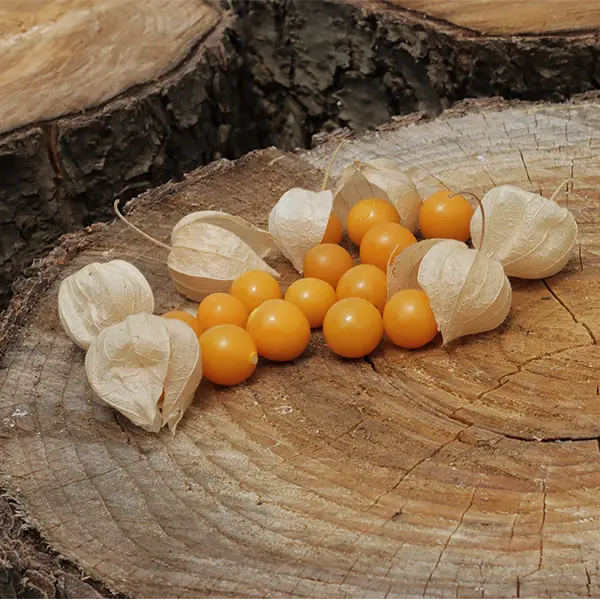
Fruits are small, round berries enclosed in a papery, lantern-shaped husk that dries to a straw colour at maturity. Berries are the edible part, with golden-orange skin and sweet-tart flesh containing small seeds; consumed fresh, dried, or in preserves.

Cultivated in warm, frost-free to light-frost conditions; self-seeds readily in suitable climates. Notable for its distinctive husk, long shelf life when dried in calyx, and ornamental appeal.

Climate

Climate Suitability:

Mild to warm frost-free conditions; suited to most SA regions as short-lived perennial

Frost Tolerance:

Frost sensitive

Heat Tolerance:

Moderate

Sun Type:

Full sun to partial shade

Soil Texture:

Sandy loam to loam

Drainage Requirement:

Well-drained

Preferred pH Range:

5.5–7.0 pH

Water Requirement:

Moderate; drought tolerant once established

Irrigation Type:

Drip; Micro Irrigation; Manual Watering

Propagation

Propagation Type:

Seed

Propagation Season:

Spring to early summer

Germination Days:

14–21 days

Days to Transplant:

28–42 days

Propagation Notes:

Sow warm; germinates readily; self-seeds in suitable conditions.

Planting

Planting Season:

Spring to early summer

Plants Per Square Foot:
Square Foot Method

0.25 per ft²

Plant Spacing:
Square Foot Method

60 cm

Plant Spacing:
Traditional Method

100–150 cm

Row Spacing:
Traditional Method

150–200 cm

Container Suitable:

Yes

Container Notes:

Hydroponic Compatible:

Conditional

Hydroponic Systems:

Hydroponic Notes:

Aquaponic Suitable:

Conditional

Aquaponic Notes:

Benefits from aromatic herbs and light interplanting; tolerates partial shade from taller companions.

No crops on recorded.

Please contact us should you feel that this is incorrect.

Avoid dense plantings that restrict airflow or increase humidity around fruit.

No crops on recorded.

Please contact us should you feel that this is incorrect.

Pests & Diseases

Pest Types:

Aphids; Whitefly; Spider Mites; Cutworms; Fruit Fly

Pest Control:

Monitor, maintain sanitation, use sticky traps and biological controls; remove infested material.

Disease Types:

Powdery mildew, Leaf spot, Damping-off, Viruses

Disease Control:

Ensure airflow, avoid overcrowding, remove infected plants and use disease-free seedlings.

Harvest

Planting Season:

Spring to early summer

Plant Spacing:
Square Foot Method

60 cm

Plant Spacing:
Traditional Method

100–150 cm

Row Spacing:
Traditional Method

150–200 cm

Nutrition

Edible Parts:

Fruit

Reference Food State:

Raw fruit

Serving Size:

100 g

Nutrition Basis:

Per 100 g raw edible portion

Calories (kcal):

53 kcal

Calories (kj):

222 kj

Total Carbohydrates:

11.2 g

Protein:

1.9 g

Total Fat:

0.7 g

Dietary Fibre:

4.9 g

Starch:

0 g

Total Sugars:

0 g

Monounsaturated Fat:

0 g

Omega-3 Fatty Acids:

0 g

Omega-6 Fatty Acids:

0 g

Polyunsaturated Fat:

0 g

Saturated Fat:

0 g

Trans Fat:

0 g

Calcium:

9 mg

Chromium:

0 mcg

Copper:

0.1 mg

Iron:

1 mg

Iodine:

0 mcg

Magnesium:

0 mg

Manganese:

0 mg

Molybdenum:

0 mcg

Phosphorus:

40 mg

Potassium:

0 mg

Selenium:

0 mcg

Sodium:

0 mg

Zinc:

0 mg

Vitamin A:

36 mcg RE

Thiamin:
Vitamin B1

0.11 mg

Riboflavin:
Vitamin B2

0.04 mg

Niacin:
Vitamin B3

2.8 mg NE

Pantothenic Acid:
Vitamin B5

0 mg

Vitamin B6:

0.06 mg

Biotin:
Vitamin B7

0 mcg

Folate:
Vitamin B9

0 mcg

Vitamin B12:

0 mcg

Vitamin C:

11 mg

Vitamin D:

0 mcg

Vitamin E:

0.37 mg alpha-tocopherol

Vitamin K:

0 mcg

Recipes