
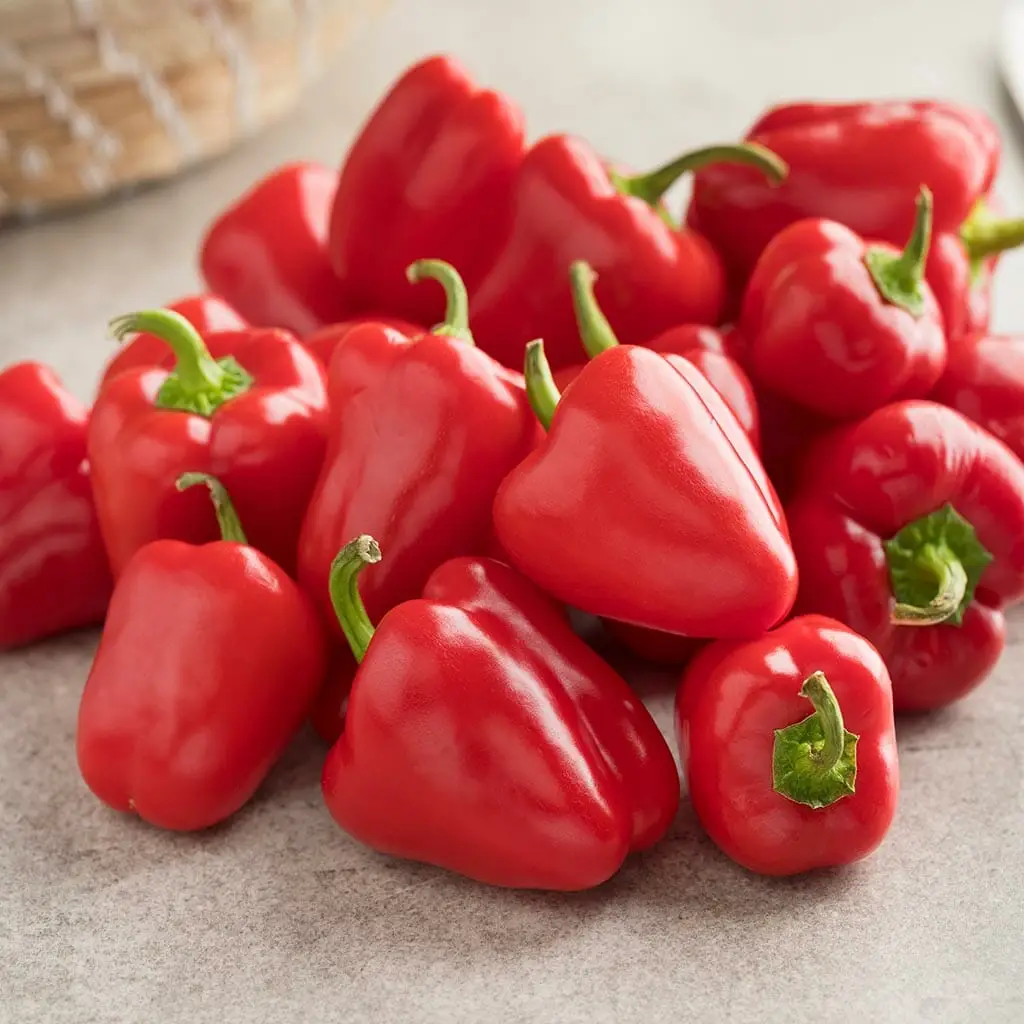
Capsicum: Baby Pepper

Botanical Name:

Capsicum annuum

Family:

Crop Type:

Other Names:

Mini Pepper; Snack Pepper; Soetpeper (Afrikaans)

Lifecycle:

Perennial, grown as annual

Uses:

Food (fresh snacking, salads, stuffed); culinary garnish

Capsicum (Baby Pepper) is a warm-season fruiting vegetable in the Solanaceae family. Plants form compact, bushy growth producing small, sweet peppers with thick, crisp flesh and minimal pith.

Fruits are typically harvested at small size in various colours including red, orange, and yellow. Fruits are the edible part, consumed fresh as snacks, in salads, or stuffed.

Cultivated in warm, frost-free conditions with consistent moisture, performing well in protected environments and containers. Baby Pepper types are noted for their snack-sized fruit, sweetness, and suitability for fresh consumption and speciality markets.

Climate

Climate Suitability:

Warm frost-free summers; tunnels improve quality; suited to most SA regions

Frost Tolerance:

Frost sensitive

Heat Tolerance:

High

Sun Type:

Full sun

Soil Texture:

Loam to sandy loam

Drainage Requirement:

Well-drained

Preferred pH Range:

6.0–6.8 pH

Water Requirement:

Moderate

Irrigation Type:

Drip; Micro Irrigation; Fertigation

Propagation

Propagation Type:

Seed

Propagation Season:

Late winter under protection to spring

Germination Days:

14–21 days

Days to Transplant:

42–56 days

Propagation Notes:

Raise seedlings in warm trays; transplant after frost risk has passed.

Planting

Planting Season:

Spring to early summer

Plants Per Square Foot:
Square Foot Method

1 per ft²

Plant Spacing:
Square Foot Method

30 cm

Plant Spacing:
Traditional Method

30–40 cm

Row Spacing:
Traditional Method

50–60 cm

Container Suitable:

Yes

Container Notes:

Hydroponic Compatible:

Yes

Hydroponic Systems:

Hydroponic Notes:

Aquaponic Suitable:

Conditional

Aquaponic Notes:

Aromatic herbs provide pest deterrence; interplant with alliums and carrots for efficient space use.

No crops on recorded.

Please contact us should you feel that this is incorrect.

Avoid continuous solanum rotation; fennel traditionally considered antagonistic.

No crops on recorded.

Please contact us should you feel that this is incorrect.

Pests & Diseases

Pest Types:

Aphids; Thrips; Whitefly; Mites; Fruit Fly

Pest Control:

Scout, use sticky traps, maintain sanitation, apply biological controls and use approved treatments when thresholds exceeded.

Disease Types:

Bacterial spot, Powdery mildew, Phytophthora root rot, Viruses (CMV, TMV)

Disease Control:

Rotate crops, maintain airflow, avoid leaf wetness, use disease-free seedlings and remove infected plants.

Harvest

Planting Season:

Spring to early summer

Plant Spacing:
Square Foot Method

30 cm

Plant Spacing:
Traditional Method

30–40 cm

Row Spacing:
Traditional Method

50–60 cm

Nutrition

Edible Parts:

Fruit

Reference Food State:

Raw sweet pepper

Serving Size:

100 g

Nutrition Basis:

Per 100 g raw edible portion

Calories (kcal):

26 kcal

Calories (kj):

109 kj

Total Carbohydrates:

6.03 g

Protein:

0.99 g

Total Fat:

0.3 g

Dietary Fibre:

2.1 g

Starch:

0 g

Total Sugars:

4.2 g

Monounsaturated Fat:

0.004 g

Omega-3 Fatty Acids:

0.024 g

Omega-6 Fatty Acids:

0.054 g

Polyunsaturated Fat:

0.072 g

Saturated Fat:

0.046 g

Trans Fat:

0 g

Calcium:

7 mg

Chromium:

0 mcg

Copper:

0.017 mg

Iron:

0.43 mg

Iodine:

0 mcg

Magnesium:

12 mg

Manganese:

0.122 mg

Molybdenum:

0 mcg

Phosphorus:

26 mg

Potassium:

211 mg

Selenium:

0.1 mcg

Sodium:

4 mg

Zinc:

0.25 mg

Vitamin A:

157 mcg RE

Thiamin:
Vitamin B1

0.054 mg

Riboflavin:
Vitamin B2

0.085 mg

Niacin:
Vitamin B3

0.979 mg NE

Pantothenic Acid:
Vitamin B5

0.317 mg

Vitamin B6:

0.291 mg

Biotin:
Vitamin B7

0 mcg

Folate:
Vitamin B9

46 mcg

Vitamin B12:

0 mcg

Vitamin C:

127.7 mg

Vitamin D:

0 mcg

Vitamin E:

1.58 mg alpha-tocopherol

Vitamin K:

4.9 mcg

Recipes