
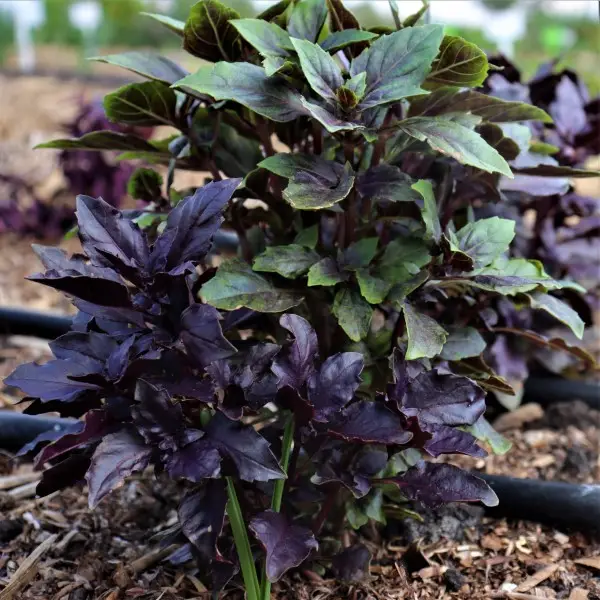
Basil: Dark Opal

Botanical Name:

Ocimum basilicum

Family:

Crop Type:

Other Names:

Purple Basil; Opal Basil; Basiliekruid (Afrikaans)

Lifecycle:

Annual

Uses:

Culinary herb (garnish, salads, vinegars); ornamental (purple foliage); pollinator attractant

Basil (Dark Opal) is an aromatic annual herb in the Lamiaceae family. Plants form compact, bushy growth with distinctive deep purple to burgundy-coloured leaves and stems, producing small pink to lavender flower spikes if allowed to bolt.

Leaves and flowers are the edible parts, offering a clove-anise flavour profile with visual appeal as a garnish. The purple pigmentation is retained when used fresh but may fade with prolonged cooking.

Cultivated as a warm-season herb requiring frost-free conditions and full sun, suited to garden beds, containers, and hydroponic systems. Dark Opal is notable for its ornamental purple foliage, which provides contrast in culinary presentations and herb gardens.

Climate

Climate Suitability:

Warm frost-free seasons; suitable for most SA summer gardens and year-round in tunnels

Frost Tolerance:

Frost sensitive

Heat Tolerance:

High

Sun Type:

Full sun

Soil Texture:

Loam to sandy loam

Drainage Requirement:

Well-drained

Preferred pH Range:

6.0–7.5 pH

Water Requirement:

Moderate

Irrigation Type:

Drip; Micro Irrigation; Manual Watering; Hydroponic Recirculating

Propagation

Propagation Type:

Seed; Cutting

Propagation Season:

Spring to summer

Germination Days:

5–10 days

Days to Transplant:

21–35 days

Propagation Notes:

Sow warm; cuttings root easily in water or moist medium.

Planting

Planting Season:

Spring to early summer after frost

Plants Per Square Foot:
Square Foot Method

4 per ft²

Plant Spacing:
Square Foot Method

15 cm

Plant Spacing:
Traditional Method

20–30 cm

Row Spacing:
Traditional Method

30–45 cm

Container Suitable:

Yes

Container Notes:

Hydroponic Compatible:

Yes

Hydroponic Systems:

Hydroponic Notes:

Aquaponic Suitable:

Yes

Aquaponic Notes:

Aromatic foliage may deter aphids and whitefly from neighbouring crops; benefits from warm microclimate near larger plants.

No crops on recorded.

Please contact us should you feel that this is incorrect.

Strong competition from dense herbs may reduce growth; rue is traditionally considered incompatible.

No crops on recorded.

Please contact us should you feel that this is incorrect.

Pests & Diseases

Pest Types:

Aphids; Whitefly; Thrips; Caterpillars; Spider Mites

Pest Control:

Scout regularly, prune affected areas, use insect netting, introduce biological controls and apply approved low-toxicity treatments if needed.

Disease Types:

Downy mildew, Fusarium wilt, Damping-off, Leaf spot, Grey mould (Botrytis)

Disease Control:

Use airflow management, avoid overhead irrigation, source resistant seed where available, remove infected material and rotate planting areas.

Harvest

Planting Season:

Spring to early summer after frost

Plant Spacing:
Square Foot Method

15 cm

Plant Spacing:
Traditional Method

20–30 cm

Row Spacing:
Traditional Method

30–45 cm

Nutrition

Edible Parts:

Leaves; Flowers

Reference Food State:

Fresh leaves

Serving Size:

100 g

Nutrition Basis:

Per 100 g raw edible portion

Calories (kcal):

23 kcal

Calories (kj):

96 kj

Total Carbohydrates:

2.65 g

Protein:

3.15 g

Total Fat:

0.64 g

Dietary Fibre:

1.6 g

Starch:

0 g

Total Sugars:

0.3 g

Monounsaturated Fat:

0.088 g

Omega-3 Fatty Acids:

0.316 g

Omega-6 Fatty Acids:

0.073 g

Polyunsaturated Fat:

0.389 g

Saturated Fat:

0.041 g

Trans Fat:

0 g

Calcium:

177 mg

Chromium:

0 mcg

Copper:

0.385 mg

Iron:

3.17 mg

Iodine:

0 mcg

Magnesium:

64 mg

Manganese:

1.148 mg

Molybdenum:

0 mcg

Phosphorus:

56 mg

Potassium:

295 mg

Selenium:

0.3 mcg

Sodium:

4 mg

Zinc:

0.81 mg

Vitamin A:

264 mcg RE

Thiamin:
Vitamin B1

0.034 mg

Riboflavin:
Vitamin B2

0.076 mg

Niacin:
Vitamin B3

0.902 mg NE

Pantothenic Acid:
Vitamin B5

0.209 mg

Vitamin B6:

0.155 mg

Biotin:
Vitamin B7

0 mcg

Folate:
Vitamin B9

68 mcg

Vitamin B12:

0 mcg

Vitamin C:

18 mg

Vitamin D:

0 mcg

Vitamin E:

0.8 mg alpha-tocopherol

Vitamin K:

414.8 mcg

Recipes