
Banana

Botanical Name:

Musa acuminata

Family:

Crop Type:

Other Names:

Plantain (cooking varieties); Piesang (Afrikaans); uBhanana (isiZulu)

Lifecycle:

Perennial, evergreen

Uses:

Food (fresh, cooked, baked); processing (chips, flour, dried); fodder (leaves and pseudostems for livestock)

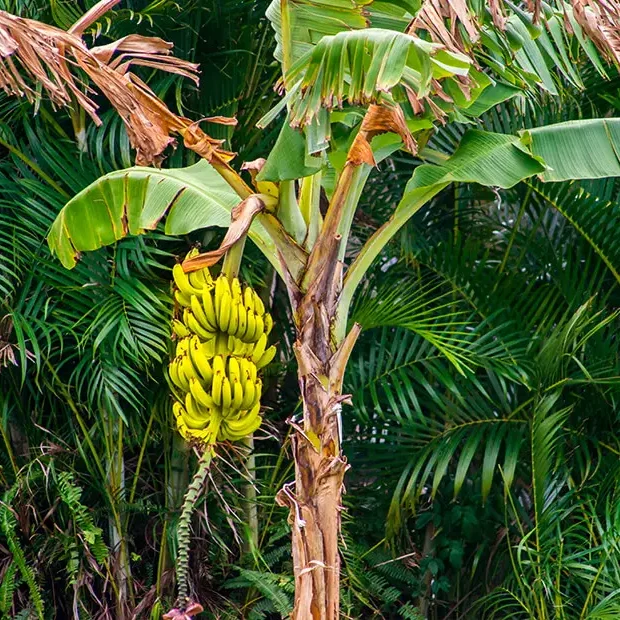
Banana is a perennial tropical to subtropical fruit crop in the Musaceae family. Plants form large pseudostems from overlapping leaf sheaths, topped by broad, elongated leaves that can reach several metres in length.

Fruit develops in hanging bunches of curved, elongated berries with yellow skin when ripe and soft, sweet flesh. The fruit is the primary edible part, consumed fresh, cooked, or processed depending on cultivar type and maturity stage.

Cultivated in frost-free regions with high humidity and consistent warmth, propagated vegetatively through suckers or tissue culture. Notable for its rapid growth cycle and year-round production potential in suitable climates.

Climate

Climate Suitability:

Humid subtropical to tropical; coastal KwaZulu-Natal, Mpumalanga Lowveld, Limpopo

Frost Tolerance:

Frost sensitive

Heat Tolerance:

High

Sun Type:

Full sun

Soil Texture:

Loam to sandy loam with organic matter

Drainage Requirement:

Moist but well-drained

Preferred pH Range:

5.5–7.0 pH

Water Requirement:

High

Irrigation Type:

Drip; Micro Irrigation; Basin Irrigation

Propagation

Propagation Type:

Sucker; Tissue Culture

Propagation Season:

Spring to summer

Germination Days:

No Data Found

Days to Transplant:

No Data Found

Propagation Notes:

Use disease-free suckers or tissue-cultured plants; avoid material from Panama disease-affected areas.

Planting

Planting Season:

Spring to early summer

Plants Per Square Foot:
Square Foot Method

No Data Found

Plant Spacing:
Square Foot Method

No Data Found

Plant Spacing:
Traditional Method

250–350 cm

Row Spacing:
Traditional Method

300–400 cm

Container Suitable:

Conditional; dwarf types in very large containers

Container Notes:

Hydroponic Compatible:

No

Hydroponic Systems:

Hydroponic Notes:

Aquaponic Suitable:

No

Aquaponic Notes:

Legume cover crops fix nitrogen; large leaves benefit from windbreaks; shallow-rooted companions can utilise space without competing for water.

No crops on recorded.

Please contact us should you feel that this is incorrect.

Avoid strong root competitors and plants requiring different moisture regimes; wind-exposed sites increase leaf damage.

No crops on recorded.

Please contact us should you feel that this is incorrect.

Pests & Diseases

Pest Types:

Banana Weevil; Nematodes; Aphids; Thrips; Mealybugs

Pest Control:

Use clean planting material, sanitation, paring of corms, trapping, mulching, monitoring and approved nematicides where necessary.

Disease Types:

Panama disease (Fusarium wilt), Sigatoka (Yellow and Black), Bunchy top virus, Bacterial soft rot

Disease Control:

Use resistant cultivars, certified disease-free planting material, remove and destroy infected plants, maintain drainage and avoid movement of contaminated soil.

Harvest

Planting Season:

Spring to early summer

Plant Spacing:
Square Foot Method

No Data Found

Plant Spacing:
Traditional Method

250–350 cm

Row Spacing:
Traditional Method

300–400 cm

Nutrition

Edible Parts:

Fruit

Reference Food State:

Raw edible portion

Serving Size:

100 g

Nutrition Basis:

Per 100 g raw edible portion

Calories (kcal):

89 kcal

Calories (kj):

372 kj

Total Carbohydrates:

22.84 g

Protein:

1.09 g

Total Fat:

0.33 g

Dietary Fibre:

2.6 g

Starch:

5.38 g

Total Sugars:

12.23 g

Monounsaturated Fat:

0.032 g

Omega-3 Fatty Acids:

0.027 g

Omega-6 Fatty Acids:

0.046 g

Polyunsaturated Fat:

0.073 g

Saturated Fat:

0.112 g

Trans Fat:

0 g

Calcium:

5 mg

Chromium:

0 mcg

Copper:

0.078 mg

Iron:

0.26 mg

Iodine:

0 mcg

Magnesium:

27 mg

Manganese:

0.27 mg

Molybdenum:

0 mcg

Phosphorus:

22 mg

Potassium:

358 mg

Selenium:

1 mcg

Sodium:

1 mg

Zinc:

0.15 mg

Vitamin A:

3 mcg RE

Thiamin:
Vitamin B1

0.031 mg

Riboflavin:
Vitamin B2

0.073 mg

Niacin:
Vitamin B3

0.665 mg NE

Pantothenic Acid:
Vitamin B5

0.334 mg

Vitamin B6:

0.367 mg

Biotin:
Vitamin B7

0 mcg

Folate:
Vitamin B9

20 mcg

Vitamin B12:

0 mcg

Vitamin C:

8.7 mg

Vitamin D:

0 mcg

Vitamin E:

0.1 mg alpha-tocopherol

Vitamin K:

0.5 mcg

Recipes