
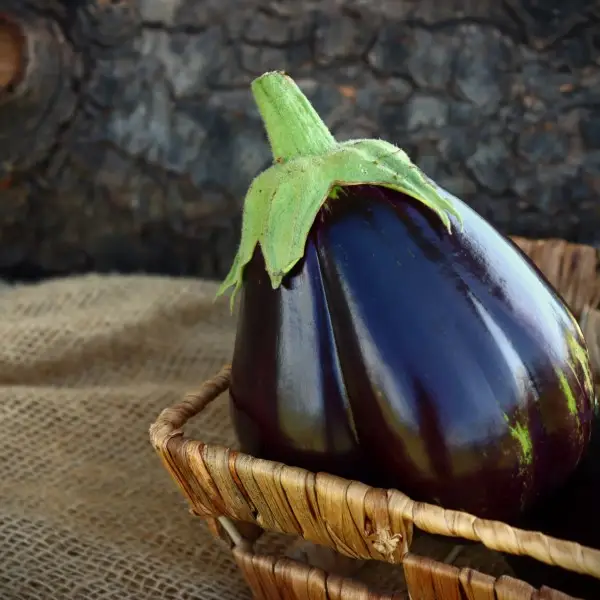
Aubergine: Black Beauty

Botanical Name:

Solanum melongena

Family:

Crop Type:

Other Names:

Eggplant; Brinjal; Eiervrug (Afrikaans)

Lifecycle:

Perennial, grown as annual

Uses:

Food (grilled, roasted, fried, stewed); culinary ingredient in curries, stews and dips

Aubergine (Black Beauty) is a warm-season fruiting vegetable belonging to the Solanaceae family. Plants produce bushy growth with large, slightly fuzzy leaves and purple-tinged stems, reaching 60–90 cm in height.

Fruits are large, oval to pear-shaped, with glossy dark purple-black skin and cream-coloured flesh containing small edible seeds. The fruit is the primary edible part, typically harvested before full maturity when the skin is glossy and flesh is firm.

Commonly cultivated in temperate to subtropical climates as a summer crop, requiring frost-free conditions and consistent warmth. Black Beauty is noted for its reliable productivity, classic appearance, and suitability for fresh market and home garden use.

Climate

Climate Suitability:

Warm frost-free summers across most SA regions; tunnels extend season in cooler areas

Frost Tolerance:

Frost sensitive

Heat Tolerance:

High

Sun Type:

Full sun

Soil Texture:

Loam to sandy loam

Drainage Requirement:

Well-drained

Preferred pH Range:

5.8–6.8 pH

Water Requirement:

Moderate

Irrigation Type:

Drip; Micro Irrigation

Propagation

Propagation Type:

Seed

Propagation Season:

Late winter under protection to spring

Germination Days:

7–14 days

Days to Transplant:

42–56 days

Propagation Notes:

Raise seedlings warm; transplant after frost.

Planting

Planting Season:

Spring to early summer

Plants Per Square Foot:
Square Foot Method

1 per ft²

Plant Spacing:
Square Foot Method

30 cm

Plant Spacing:
Traditional Method

50–70 cm

Row Spacing:
Traditional Method

75–90 cm

Container Suitable:

Yes; large containers

Container Notes:

Hydroponic Compatible:

Conditional

Hydroponic Systems:

Hydroponic Notes:

Aquaponic Suitable:

Conditional

Aquaponic Notes:

Benefits from aromatic herbs that deter pests; legumes improve soil nitrogen; avoid other solanums in rotation to reduce disease pressure.

No crops on recorded.

Please contact us should you feel that this is incorrect.

Solanums in rotation increase shared pest and disease pressure; fennel may inhibit growth.

No crops on recorded.

Please contact us should you feel that this is incorrect.

Pests & Diseases

Pest Types:

Aphids; Whitefly; Spider Mites; Fruit Borer; Cutworms

Pest Control:

Use crop rotation, scouting, biological controls, yellow sticky traps and remove infested material; apply approved insecticides only when thresholds exceeded.

Disease Types:

Verticillium wilt, Bacterial wilt, Powdery mildew, Phytophthora root rot, Damping-off

Disease Control:

Rotate solanums (3–4 years), use resistant varieties where available, avoid waterlogging, remove infected plants, improve airflow and use disease-free seedlings.

Harvest

Planting Season:

Spring to early summer

Plant Spacing:
Square Foot Method

30 cm

Plant Spacing:
Traditional Method

50–70 cm

Row Spacing:
Traditional Method

75–90 cm

Nutrition

Edible Parts:

Fruit

Reference Food State:

Raw edible portion

Serving Size:

100 g

Nutrition Basis:

Per 100 g raw edible portion

Calories (kcal):

25 kcal

Calories (kj):

104 kj

Total Carbohydrates:

5.88 g

Protein:

0.98 g

Total Fat:

0.18 g

Dietary Fibre:

3 g

Starch:

0 g

Total Sugars:

3.53 g

Monounsaturated Fat:

0.016 g

Omega-3 Fatty Acids:

0.013 g

Omega-6 Fatty Acids:

0.063 g

Polyunsaturated Fat:

0.076 g

Saturated Fat:

0.034 g

Trans Fat:

0 g

Calcium:

9 mg

Chromium:

0 mcg

Copper:

0.081 mg

Iron:

0.23 mg

Iodine:

0 mcg

Magnesium:

14 mg

Manganese:

0.232 mg

Molybdenum:

0 mcg

Phosphorus:

24 mg

Potassium:

229 mg

Selenium:

0.3 mcg

Sodium:

2 mg

Zinc:

0.16 mg

Vitamin A:

1 mcg RE

Thiamin:
Vitamin B1

0.039 mg

Riboflavin:
Vitamin B2

0.037 mg

Niacin:
Vitamin B3

0.649 mg NE

Pantothenic Acid:
Vitamin B5

0.281 mg

Vitamin B6:

0.084 mg

Biotin:
Vitamin B7

0 mcg

Folate:
Vitamin B9

22 mcg

Vitamin B12:

0 mcg

Vitamin C:

2.2 mg

Vitamin D:

0 mcg

Vitamin E:

0.3 mg alpha-tocopherol

Vitamin K:

3.5 mcg

Recipes